
CNN Dec 7 2007
GENEVA, Switzerland (AP) -- Myanmar's crackdown on pro-democracy protesters killed more than twice as many people as the junta has acknowledged, a U.N. investigator said Friday, citing at least 31 dead.
The U.N.'s Paulo Sergio Pinheiro shown arriving in Yangon, Myanmar, in November. Paulo Sergio Pinheiro, the U.N. human rights expert assigned to the country, said he documented 16 people killed in the September crackdown along with the 15 dead already reported by the government.
But he said the actual death toll was likely much higher.
"Several reports of killings indicate that the figure provided by the authorities may greatly underestimate the reality," he said.
"There are a number of incidents where no names were reported but where there were allegations of groups of people reportedly killed, which have also been shared," Pinheiro said in a report released by the U.N. on Friday.
Pinheiro, who visited Myanmar on November 11-15, said "credible sources" reported a large number of bodies wrapped in plastic and rice bags that were burned in the early hours of the final days of September. The burning took place at the Ye Way crematorium in Yangon. Authorities blocked Pinheiro from visiting.
"Sources indicate that it was not usual practice for the crematorium to operate during the hours in question, that normal employees were instructed to keep away, and that the facility was operated on those nights by state security personnel or state-supported groups," Pinheiro said.
At least one report indicated that some of those cremated had shaved heads, indicating they were monks, and some had signs of serious injuries.
Myanmar had earlier said only 10 people died during the nationwide suppression of demonstrations led by Buddhist monks angry at continued military rule of the Southeast Asian nation also known as Burma.
Pinheiro said the report lists the names of "653 persons detained, 74 persons disappeared and 16 killed -- in addition to the list of 15 dead provided by the authorities."
His report includes details of a visit to the Htain Bin crematorium, where authorities said 14 corpses were transferred from the Yangon General Hospital.
The bodies were registered and cremated, but three of the dead could not be identified. Eleven of those cremated died as a result of firearm wounds.
Pinheiro also said he received "credible reports" from a monk detained between September 27 and October 5 that at least 14 individuals died in custody. These included eight monks and one boy, who died on the first day, the monk told Pinheiro, adding that the deaths were due to poor conditions in detention.
Pinheiro said he heard that Win Shwe, a member of Aung San Suu Kyi's pro-democracy movement, died during questioning in Plate Myot Police Center, near Mandalay, on October 9. His body was not returned to his family, Pinheiro said.
U Thilavantha, the deputy abbot of the Yuzana Kyaungthai monastery in Myitkyina, allegedly was beaten to death in detention on September 26, Pinheiro said.
Pinheiro said he expressed his concern to Myanmar's government regarding the allegations and hoped future investigations could shed light on what happened.
"The allegation of the burning of a large amount of bodies ... is very disturbing," Pinheiro said. "It may explain why the government has not been able so far to provide information on the whereabouts of a number of detainees and missing persons.
"It may also explain the numerous reports received about the removal of dead bodies by the security forces during the crackdowns and night raids on some monasteries."
He urged the government to return the remains of all the dead to their families, so that they can be given proper funerals.
On Monday, national police chief Brig. Gen. Khin Yi said that 2,927 people, including 596 monks, were detained in connection with the protests, but that only 80 people, including 21 monks, remain in custody.
Pinheiro estimated the government arrested 3,000 to 4,000 people in September and October and that between 500 and 1,000 are still detained.
Other credible reports convinced Pinheiro that relatives of people in hiding were seized as hostages by security forces during night raids, he said.
Earlier Friday, Human Rights Watch also said the military killed far more than it has acknowledged. The New York-based group said in a report that it had documented the deaths of 20 protesters, but believes that many more Buddhist monks, students and other civilians were killed.
U.N. raises Myanmar crackdown toll
08 December 2007 Labels: News

What is the answer to Burma?
04 December 2007 Labels: EssaysA friend of mine sent me the latest news about U Gambira, who is the leader of All-Burma Monks Alliance (ABMA). He has been charged with treason; a crime punishable by death. As the news slowly sank in, the same question, that has been bugging me for the past few weeks, appeared in my mind again.
WHAT IS HAPPENING TO BURMA?
For the past few months, the news that we heard in the various media (both Burmese and English) simply made us speechless. Never would we have imagined such things happening in our beloved country, Burma, which is well-known for its friendly and kind people and its sense of tranquility. Now, everything in Burma has been replaced by fear and uncertainty.
A few days ago, Maggin monastery, which had a large number of monks participating in September peaceful protests, was closed down by the military junta and the remaining monks (including 80-years old U Nandiya, father of the monastery’s abbot, U Indaka) were evicted from the monastery [Source]. All the HIV/AIDS patients who were seeking treatment and solace in the monastery were also made homeless at a short notice. Though U Nandiya requested for a few days of grace period so that the well-beings of the young monks and patients can be taken care of, his request was rejected. I heard on BBC News that upon eviction, U Nandiya and the young monks had to linger around in the area for a while as the soldiers warned the passerby not to offer help or get involved.
Nowadays, the monks in Burma are not free to travel from town to town. Whenever they travel to somewhere (especially to Rangoon), they will be questioned endlessly as if they were criminals. If they were not able to produce the relevant documents, they would even be asked to go back to their hometowns. In a country where Buddhism is supposed to flourish, instead of being considered as the most revered kind, the monks are being treated as outcasts. What a sad irony!! How did all this happen? Why do Burmese people look away helplessly at such happenings?
U Gambira's mother told RFA in this interview about her anguish at having her two sons (U Gambira & his elder brother) and husband in prison with her daughter-in-law on the run and also having to fend for herself as well as for her three small grand-children. When the military junta could not arrest U Gambira, they arrested his elder brother and father and that eventually led to the arrest of U Gambira. Apart from arresting family members of the activists, the junta also does everything to hinder the livelihood of such families. The junta will halt their businesses (if any) and make things so difficult for the family members that they will end up having to struggle a lot for survival.
Burmese people are very kind-loving by nature and are dedicated to their families. Most of all, they consider filial piety as something of utmost importance. The military junta is making use of such kind nature of Burmese people to instill "fear" in them; fear for the safety and well-being of loved ones.
Under this ruthless strategy of the military junta, many sacrifices have been made. When the parents of two of 88-generation student leaders passed away, they were not allowed to attend the funeral of their parents. Their parents left this world, without being able to see their children for the last time. For Burmese people, we believe that when our parents pass away, all the children should be well and present at their death-beds so that they will leave this world peacefully. As children, it is also part of our filial piety to make sure that our parents live their last moments on earth without any worry. Hence, please do try to put yourself in the shoes of those 88-generation student leaders. How sad would they have felt?
As the military junta continues to turn Burma upside down through more arrests and torture on monks, civilians and student leaders, the international pressure on Burma seems to be waning. At the recent ASEAN Summit, ASEAN members allowed the junta, that has committed such atrocious crimes, to raise objection at Mr. Gambari's plan to address the ASEAN leaders. Such action seems to let the military junta into thinking that they can continue their nonchalant attitude towards ASEAN's stand of urging towards the political reforms as soon as possible.
Many members in ASEAN feel that sanctions do not help the civilians in Burma. Yes, it is true. However, neither does not having sanctions help the Burmese people. In fact, the main effect that sanctions can have is on the circle of military junta. The most effective and recent sanction in my opinion, led to the closure of Air Bagan airline, owned by Tayza who has very close relationship with the top general of the military junta. In Tayza's statement to public, he mentioned about the loss that the Burmese people would suffer due to his airline's closure. What a joke! Though there is an undeniable fact that some normal civilians have lost their jobs at Air Bagan due to the closure, the significance is rather minute. All along, only the people related to the junta's circle has benefitted most from the business of Air Bagan. NOT the normal civilians on the street. When the Bagan Airline was in business, Burma was still considered as the poverty-stricken third-world country.
Many people say that freedom for Burma must be through the movement by its own people. I totally agree. While my fellow Burmese people in Burma are making sacrifices, many of us outside Burma are also trying our best to help them as well as to gather help from the international community. We are all doing what we can.
In the meantime, many lives are still being lost, tortured, and ruined in Burma. How many more will come? The answer simply lies in our unity, our commitment, and our belief to free Burma from the hands of evil. Therefore, we implore to the international community to lend your support to save the monks and people of Burma.
Burma: Junta Charges Monks' Leader With Treason
Labels: NewsMonday, 3 December 2007, 9:24 am
Press Release: Terry Evans
[SOURCE LINK]
The leader of the All-Burma Monks Alliance (ABMA) has been arrested and charged with treason for his role in the September pro-democracy demonstrations. Treason is a capital crime in Burma. If convicted and executed, 27 year-old U Gambira would be the first monk to be put to death in Burma since the British colonial rulers hanged a monk who lead a rebellion 70 years ago.
U Gambira was instrumental in getting tens of thousands of monks onto the streets in peaceful protests during September. The anti-regime demonstrations, which began over the peoples' agitation against the fuel price hike in mid-August, came to an abrupt end after a brutal crackdown by the junta.
By the end of September the monks' leader went in hiding, and in an attempt to force U Gambira out into the open the generals resorted to hostage taking by arresting several members of his family. This tactic worked and during November the peaceful protest leader was captured.
Since U Gambira's arrest his exact whereabouts remain unconfirmed officially. However reliable reports indicate that he is being kept in Cell Block 1 at Insein Prison in Rangoon. Cell Block 1 is notorious as the junta's main interrogation centre for political prisoners.
Just prior to his arrest U Gambira asked for following statement to be released:
"To Buddhists all over the world and activists and supporters of Burmese movement, please help to liberate the Burmese people from this disastrous and wicked system. To the many people of the world who are sympathetic to the suffering of the Burmese people, please help us to be free from this evil system. Good people in Burma are being killed or imprisoned, tortured, and then sent to forced labour camps. I sincerely ask the international community to do something to stop these atrocities. My chances of survival are very slim now. But I have not given up hope, and will try my best."
U Gambira is the pseudonym of a leader of the All-Burma Monks Alliance
BBC Burmese Interview with a HIV/Aids patient at Maggin Monastery
Labels: interview, NewsBBC Burmese Interview with a HIV/Aids patient at Maggin Monastery
September 27, 2007
(Unofficial translation)
Min Htet: Another monastery that was raided along with Ngwaykyaryan is Maggin monastery. It is a monastery that has cared for the HIV/Aids patients. The security forces raided the monastery around midnight and took many monks into custody. A man who was at the monastery during the raid recounted his experience to BBC.
Unidentified eyewitness: I heard the whistling at about midnight last night. It was a signal (to initiate the raid). Then they came, scaling over the walls. I heard running footsteps – the sound of rubber soles rapidly hitting the ground – coming toward us. So I got up and looked out. I saw a sea of soldiers on the road. As soon as I saw the solders and sensed the imminent raid, I went around waking up the patients. I told them that we had been surrounded by security forces.
Min Htet: When you say "patients" are you talking about HIV/Aids patients, staying at the monastery to receive medical care?
Eyewitness: Yes. After waking up the patients, I told them that we had been surrounded and then I went to check if we could get away through the back door. But the security forces were there already. There had also taken position near the toilet.
Min Htet: So the soldiers were already within the monastery compound at that time?
Eyewitness: There were soldiers everywhere – both within the premises and on the road outside the monastery.
Min Htet: Were they soldiers or police?
Eyewitness: There were soldiers. The security forces also included (members of) Swan Err Shin and USDA (civilian militias). I saw thick sticks in their hands. We were in the building in the back of the premises; there is another building in front of our building, which is occupied by the abbot, novices and other monks. The security forces went up into that building. They grabbed the monks by their necks, pushed them about and beat them up with sticks. They hit the monks with the sticks and dragged them out of the building. The novices were asleep at the time. The soldiers went into the monastery with their combat boots on. Then they dragged the novices out shouting, "Is there anyone left in the building? Is there anyone left in the building?" They also asked the monks if there were any monks left in the building. They shouted, "Don't lie to us! Are there any monks left in the building?" They were scolding and shouting at the novices. The novices were shaking with fear. The raid took place as if the soldiers were attacking a rebel position.
Min Htet: So the raid was concentrated on the monastery building where the abbot resides?
Eyewitness: Yes, in the building where he lives. Then the security forces came to our building. We have patients staying on the ground floor. The soldiers dragged the patients out of the building. They literally dragged them across the floor out of the building. The patients took out their patient registration papers and told the soldiers that they are HIV/Aids patients. The soldiers stopped once they knew who the occupants of the building were, but then there were other security forces who did not know this and they tried to force the patients out of the building. It happened three or four times and only after the patients had shown the soldiers their papers did they fully realize the situation and stop the harassment.
Min Htet: So the soldiers stopped dragging the patients out of the building?
Eyewitness: Yes, they did; they stopped dragging the patients out forcibly.
Min Htet: How about the monks?
Eyewitness: There were four monks in the building and all four of them were detained. The abbot was taken as well. The abbot, U Einnaka, was detained as well. The soldiers also took away the father of the abbot, who is also a monk and 84-years-old. The soldiers started their raid on the ground floor and then went up to the upper floor. I could hear the sounds of combat boots walking on the upper floor. Although I was in the upper floor of another building, I was shaking with fear. Then they came up to the upper floor where I was. They pushed the door open from outside. Still shaking, I got up and opened the door. They rushed into the room, grabbed my hands and immediately tied them up. I told them that I am a patient. I begged and explained to them that I came here to get medical treatment and that I am an HIV/Aids patient. Then someone I believe was the ringleader said, "Leave them be if they are patients." Then they looked inside the mosquito nets to see if any monks were hiding there. They held the monks by their necks and pushed them out of the building while kicking and hitting them. The father of the abbot, the old monk, was treated in the same way while he was taken away.
Min Htet: How about the novices?
Eyewitness: They left the novices at the monastery. They hit them and dragged them out of the building and ordered them to sit on the ground. But they left the novices after beating them.
Min Htet: Were any of the novices injured?
Eyewitness: They did not sustain any visible injuries. But even if the monks were injured, they dared not talk back to the soldiers. The patients did not dare question the soldiers. The soldiers were behaving as if they were going to kill us. They had looks of killers. So we did not talk back at all. We were shaking with fear so I could not even dare breathe during the raid, let alone question their authority.
Min Htet: How many soldiers were there, you reckon?
Eyewitness: There were about 100 of them, both inside and outside the monastery premises.
Min Htet: Did you see how the abbot was taken away?
Eyewitness: The abbot had his robe pulled over his head. He was pushed and dragged by his neck. The soldiers also used their rifle butts to poke at him to urge him forward. That's how the abbot was taken away.
Min Htet: Ma Yi Yi Aung, that was the eyewitness recounting what he saw during the raid at Maggin monastery last night, how the soldiers treated the monks and how they were taken away for detention.
(Thanks to a friend of mine who sent this translated information to me. FTC)
Protest by Burmese people in Singapore against the outcome of ASEAN SUMMIT
27 November 2007 Labels: News, VideosOn 20th November 2007, a group of 50 burmese people staged a short peaceful protest at downtown area of Singapore, Orchard Road. The protest came about due to their disappointment after hearing ASEAN's non-interfering stand towards Burma and ASEAN's decision to respect the so-called wishes of SPDC (Burmese military junta). The protestors wore red t-shirts with wordings such as "Please save the monks and people of burma" .. "We pursue peace, justice and democracy for Burma". They also held pieces of paper urging ASEAN to "act with honour". They stood in rows of 3 and the first row of 3 people held a banner that stated as such: "Listen to Burma's desire. Dont follow junta's order".
Click below to see the video footage of the protest.
Rumor or Hoax of Daw Aung San Suu Kyi' Health
Labels: EssaysRecently, people have received one circulation, which written rather shocking news about Burma national leader Daw Aung San Suu Kyi.
It strongly mentions that she was under the attempt to assassinate with mysteriously arranged poisonous water supply.
That's not the fresh news actually. Rumor had been surfaced in October that she was given lethal injection which weaken and die gradually without cause. But after a few phone enquiry and confirmation by undependable sources, instantly aired by some media, the bad news was temporarily gone away from worrisome minds. People are very cautious for the fact that injection seems impossible for the one who has been always looked after by trustworthy personal doctor.
This time, the mode was just briefly changed to water supply instead of injection. Believed that source of the news is reportedly released from government side.
Surprising is that all of the media including official radio services are silent for this second time.
why?
They may think of just rumor or hoax speculated by authority make to confuse and complex among the pro democracy groups.
On the other hand, people are really confused and worried with the thought what if it's real.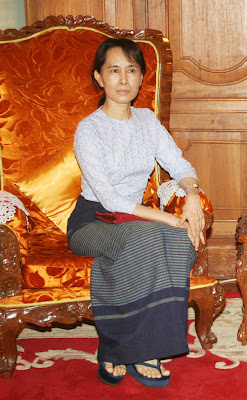
In this lastest public seen photo, she looks so pale and frail. We just simply don't know exactly she is in good health or not. She is drinking contaminated water or not.
Why not to be serious!
Undoubtedly, it is likely to be possible. Because Daw Aung San Suu Kyi is the only one who can influent to Burma political changes and the whole world put credit and tipped her name for that changes. It seems like all pressure and responsibilities are on her shoulder. For that sense, the stupid and wicked generals may realize that she is the one they have to destroy for their survival. Like their nature, they really won't care whatever the consequences.
More evidently, some stories about Burma notorious prisons were widely known among people. So many instances were shown unknown deaths shortly after the release from imprisonments. Some medical professionals doubted that these political prisoners had consumed lead (or) mercury contaminated water for specific period.
We are here to highlight these possible atrocities and make know the world to give first priority to immediate release of Daw Aung San Suu Kyi and all other political prisoners. We are wondering any of expert advice to form a team examining whether there is such a torture using chemical and biological weapons in Burma.
Please save our leader and political prisoners.
Encouragement from Poland
26 November 2007 Labels: StatementsBurma letter initiated by Lech Wal ๊sa
and published in Gazeta Wyborcza on September 27 2007
This is a rough translation:
We, the participants in the negotiations, which in 1989 enabled Poland to
move without bloodshed from dictatorship to democracy, express our
admiration and our solidarity with the hundreds of thousands of Burmese
people who through their brave demonstrations have shown that they want the
same for their own country. Just as Poland's democratic movement could count
in its struggle on the support of democrats around the world so You can now
count on us. We call on the military authorities in Burma to enter on the
path of negotiations, as did the Polish authorities in 1989. In Burma today,
as in Poland then, only a peaceful transition to democracy lies in the
interest of the whole of society. Those of us who were on the official side
in 1989, can assure you that today we consider it a good thing that we had
enough courage to hand power over democratically. Those of us who in 1989
were on the side of the opposition assure you that today that it is a good
thing that we had enough courage to set aside the temptation to take
revenge. Both one side and the other consider that the crimes committed in
the past should be justly punished but the future cannot be built on acts of
revenge. Should the Burmese society and authorities wish it, we are ready
to serve them with our experience and help.
Signed:
Lech Wal ๊sa, former Polish president, leader of the Solidarity movement from
1980 to 1990
Bronislaw Geremek, MEP, former Polish foreign minister, one of the leaders
of Solidarity from 1980 to 1989
Aleksander Hall, Polish oppositionist from 1977 to 1989, participant in the
1989 negotiations
Wojciech Jaruzelski, retired general, Polish Communist leader from 1981 to
1989, imposed martial law in Poland in 1981
Czeslaw Kiszczak, retired general, Minister of the Interior from 1981 to
1990
Aleksander Kwasniewski, former Polish president (two terms: 1995-2000 and
2000-2005) Communist party youth activist from 1978 to 1990
Tadeusz Mazowiecki, former Polish prime minister, one of the leaders of the
Solidarity movement, 1980 - 1989
Adama Michnik, editor of Gazeta Wyborcza, former oppositionist, served long
prison sentence in 1980s
Janusz Onyszkiewicz, MEP, former Defence Minister, Solidarity activist 1980
to 1989
Mieczyslaw Rakowski, the last head of the Polish Communist Party, deputy
premier during the imposition of martial law
Janusz Reykowski, profesor of social psychology, Communist party supporter
from 1980 to 1990
Marcin Swiecicki, former communist party member, participant In 1989
negotiations
-----
(Many thanks to a friend of mine who forwarded this statement to me.)
FTC